

As the Q2 earnings season wraps, let’s dig into this quarter’s best and worst performers in the telecommunication services industry, including Array (NYSE:AD) and its peers.
The sector is a tale of two cities. Satellite telecommunication is generally buoyed by rising global demand for connectivity in costly-to-connect and remote areas. On the other hand, terrestrial telecommunication companies face an uphill battle, as they mostly sell into a deflationary market, where the price of moving a bit tends to decrease over time with better technology. Despite the differences in demand drivers, companies across the entire industry must contend competition from larger telecom conglomerates and hyperscalers expanding their own networks as well as newer entrants such as SpaceX's StarLink.
The 6 telecommunication services stocks we track reported a mixed Q2. As a group, revenues missed analysts’ consensus estimates by 1.7%.
While some telecommunication services stocks have fared somewhat better than others, they have collectively declined. On average, share prices are down 2.2% since the latest earnings results.
Best Q2: Array (NYSE:AD)
Operating as a majority-owned subsidiary of Telephone and Data Systems since its founding in 1983, Array (NYSE:AD) is a regional wireless telecommunications provider serving 4.6 million customers across 21 states with mobile phone, internet, and IoT services.
Array reported revenues of $54.07 million, up 89.5% year on year. This print exceeded analysts’ expectations by 3.3%. Overall, it was a stunning quarter for the company with a beat of analysts’ EPS estimates.
"Array continues to make nice progress executing across our 2026 priorities," said Anthony Carlson, President and CEO.
Array scored the biggest analyst estimate beat and fastest revenue growth of the whole group. The results were likely priced in, however, and the stock is flat since reporting. It currently trades at $35.96.
Is now the time to buy Array? Access our full analysis of the earnings results here, it’s free.
Lumen (NYSE:LUMN)
With approximately 350,000 route miles of fiber optic cable spanning North America and the Asia Pacific, Lumen Technologies (NYSE:LUMN) operates a vast fiber optic network that provides communications, cloud connectivity, security, and IT solutions to businesses and consumers.
Lumen reported revenues of $2.81 billion, down 9.3% year on year, outperforming analysts’ expectations by 2.4%. The business had an exceptional quarter with a beat of analysts’ EPS estimates.
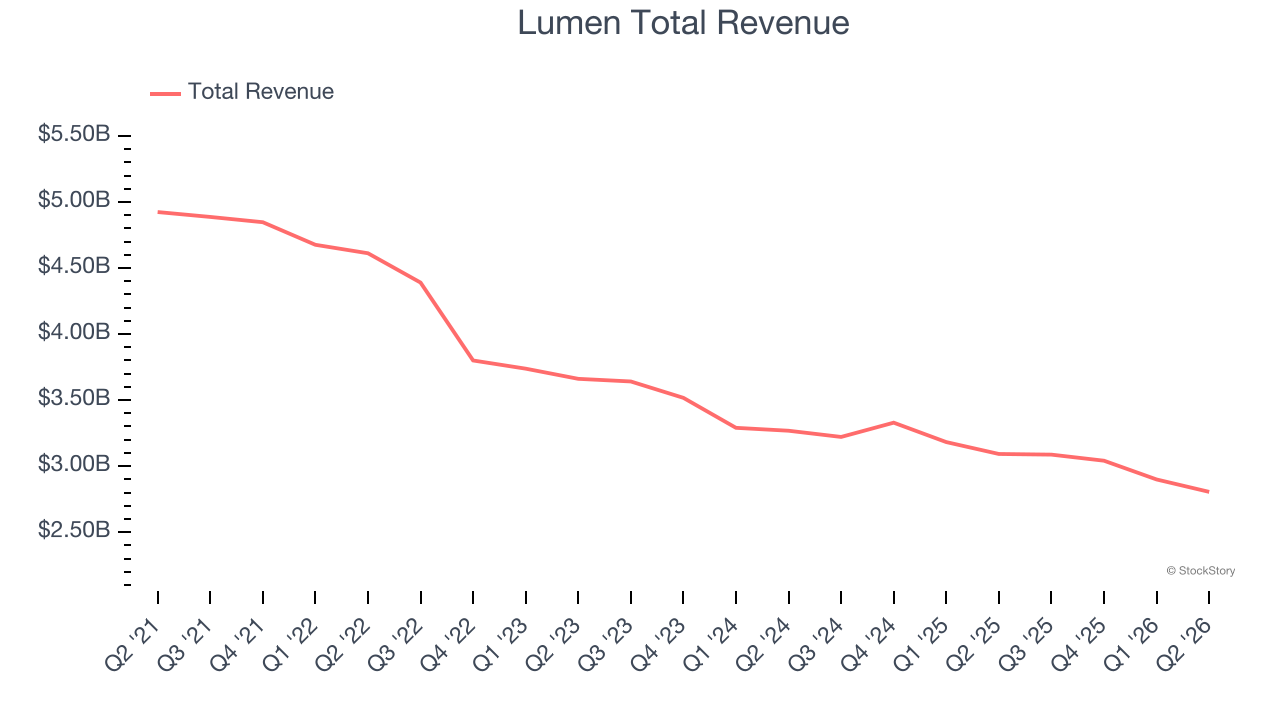
However, the results were likely priced into the stock as it’s traded sideways since reporting. Shares currently sit at $6.73.
Is now the time to buy Lumen? Access our full analysis of the earnings results here, it’s free.
Weakest Q2: Globalstar (NASDAQ:GSAT)
Known for powering the emergency SOS feature in newer Apple iPhones, Globalstar (NASDAQ:GSAT) operates a network of low-earth orbit satellites that provide voice and data communications services in remote areas where traditional cellular networks don't reach.
Globalstar reported revenues of $64.77 million, down 3.5% year on year, falling short of analysts’ expectations by 11.2%. It was a disappointing quarter as it posted a significant miss of analysts’ EPS estimates.
Globalstar delivered the weakest performance against analyst estimates among its peers. As expected, the stock is down 2.3% since the results and currently trades at $81.52.
Read our full analysis of Globalstar’s results here.
Cogent (NASDAQ:CCOI)
Operating a massive network spanning 20,000 miles of fiber optic cable and connecting to over 3,200 buildings worldwide, Cogent Communications (NASDAQ:CCOI) provides high-speed Internet access, private network services, and data center colocation to businesses and bandwidth-intensive organizations across 54 countries.
Cogent reported revenues of $235.6 million, down 4.3% year on year. This number came in 1.7% below analysts’ expectations. Aside from that, it was a strong quarter as it recorded a beat of analysts’ EPS estimates.
The stock is down 14.1% since reporting and currently trades at $11.06.
Read our full, actionable report on Cogent here, it’s free.
Viasat (NASDAQ:VSAT)
Operating a fleet of 23 satellites that orbit the Earth and beam connectivity from space, Viasat (NASDAQ:VSAT) provides satellite-based communications networks and services for airlines, maritime vessels, governments, businesses, and residential customers worldwide.
Viasat reported revenues of $1.16 billion, down 1.2% year on year. This print missed analysts’ expectations by 4.4%. More broadly, it was actually a satisfactory quarter as it put up a beat of analysts’ EPS estimates.
The stock is down 3.7% since reporting and currently trades at $83.
Read our full, actionable report on Viasat here, it’s free.
Market Update
Over the past year, investors have been forced to repeatedly answer the same question: what is the market’s biggest risk? The answer has changed several times, and each shift has reshaped market leadership.
Late in 2025 and early 2026, artificial intelligence became the market’s primary uncertainty. Investors questioned whether AI would erode software pricing power and weaken competitive moats as AI made it easier to replicate once-differentiated products.
By the spring, technology took a back seat to geopolitics. The U.S. conflict with Iran briefly became the market’s dominant narrative, raising concerns about oil prices, inflation, and global growth. But as energy markets remained orderly and fears of a prolonged supply disruption faded, investors quickly turned their focus back to fundamentals.
Want to invest in winners with rock-solid fundamentals? Check out our Top 5 Quality Compounder Stocks and add them to your watchlist. These companies are poised for growth regardless of the political or macroeconomic climate.